
Jason Sikoak is an interdisciplinary artist from Rigolet, an Inuit community in Labrador. Now based in Tiohtiá:ke/Montreal, he holds a Bachelor’s degree in Visual Arts and Art History from Concordia University, where he is currently pursuing a Master’s in Fibres and Material Practices. His work, deeply influenced by his Inuit identity, explores the connections between art, craft, culture, sexuality, and memory.
He has exhibited in several renowned institutions, including La Guilde, The Rooms, and the Winnipeg Art Gallery, and his work has been published in magazines such as Inuit Art Quarterly and Inuktitut Magazine. Two of his creations were selected by the Royal Canadian Mint. Inspired by the stories of his Elders and his cultural heritage, Sikoak engages in an ever-evolving artistic practice that challenges colonial narratives and expands the boundaries of contemporary Inuit art.


Artwork description
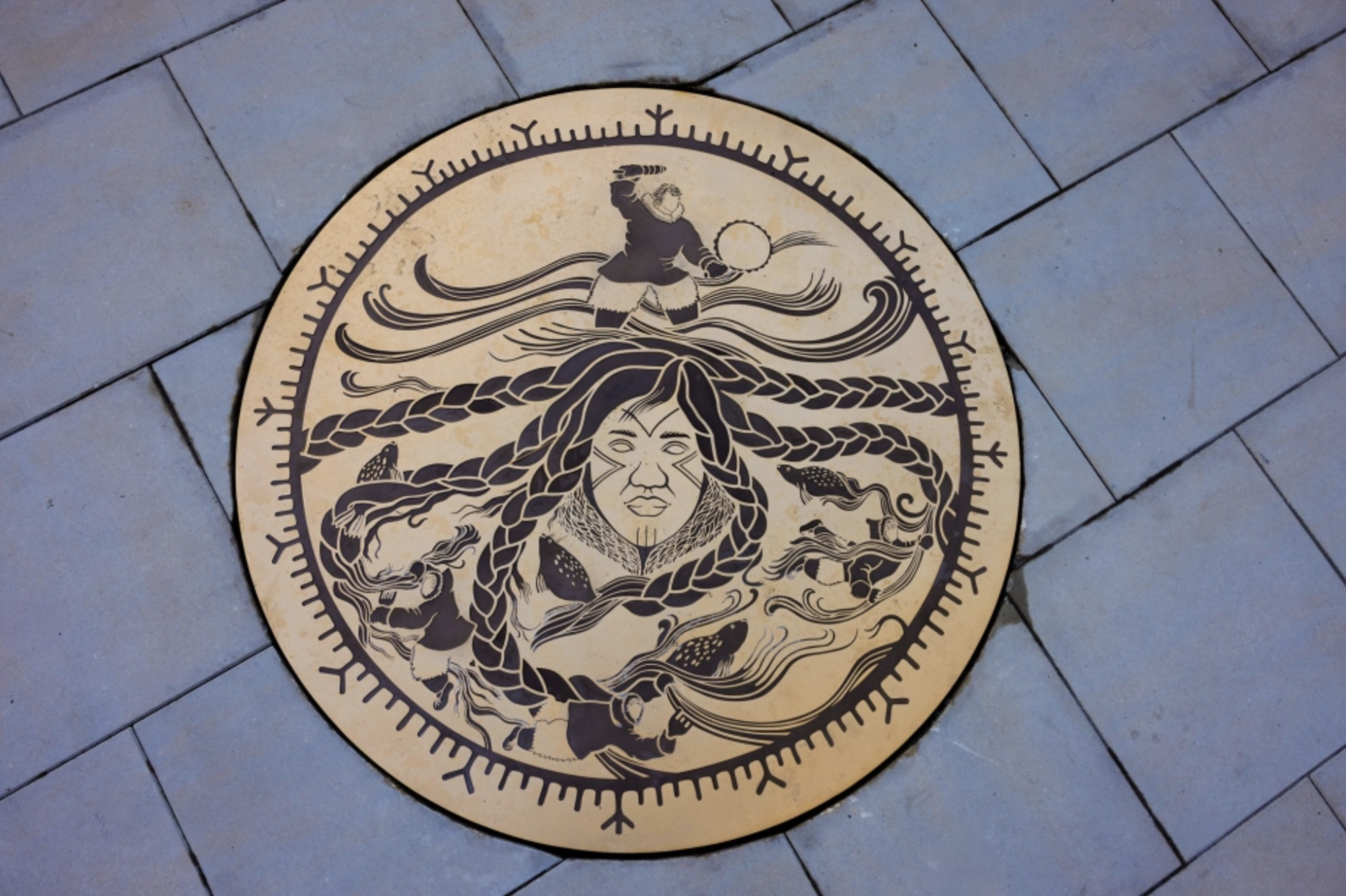
A bronze medallion, A Song for Nuliajuk by Jason Sikoak, is embedded in the Hall terrace’s circular seating area. The bronze serves as both a focal point and a gathering space. It is also symbolic of a ceremonial fire—a place for reflection, storytelling, and communal presence.
The medallion illustrates an Inuit ceremony meant to honour and appease Nuliajuk, also known as Sedna—a figure whose name and story vary across Inuit Nunangat and the Circumpolar North. Like other versions, this one offers a clear moral: when humans behave unjustly toward one another or the natural world, balance is disrupted, and repair becomes necessary.
In Inuit oral traditions, Nuliajuk’s hair carries the well-being of sea life. When she is angered by human actions, her hair tangles, trapping sea mammals underwater and depriving them of sustenance. To express care and apology—and a commitment to do better—people sing, drum, comb, and braid her hair.
Sikoak depicts this ceremony in the present tense. While Nuliajuk’s hair is being tended, loose strands remain, indicating that the care and repair process is ongoing and incomplete.
Positioned within a public seating area, A Song for Nuliajuk encourages contemplation of accountability, interdependence, and the ongoing work of repair.