

Currently lives in the south of Chile, in the rural area of Villarrica.
By profession Graphic, dedicated to painting and illustration since 2005.
Aner’s work is marked by elements of nature, leaves, roots, plants, tree bark, they dialogue with characters with native features, generating dream stories, where perspectives, elements and meanings are transposed.
Along the path of mural painting, he has been able to leave his traces in different latitudes such as Brazil, Argentina, Paraguay, Bolivia, Colombia, Canada, Mexico and France.


Artwork description
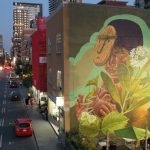
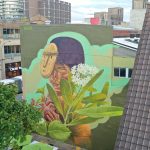
The Piwkentukun mural is a memorial dedicated to the Indigenous children of Canada and, more broadly, to the native peoples of the Americas.
The etymological definition of the word “remember” is to go back through the heart, explains Aner Urra. For the Mapuche visual artist, who spent several weeks in Montreal designing and creating the Piwkentukun mural, remembering means “taking our hearts and remembering” in a restrained manner, neither disorderly nor violent, but rather conscious of what happened, without omitting anything.
“Remembering the historical genocide of Indigenous peoples throughout the Americas and during the dictatorship in Chile, as well as the discovery of [unmarked] graves of Indigenous children in Canada. I wanted to incorporate all of this into the mural through various visual symbols.” Quote from Aner Urra, muralist.
The artist explained that the symbolic elements he chose for the work were not random.
The child, for example, represents innocence holding the past in his hands in the form of a heart.
“When a human being uses his hands to act on something, he can cultivate, sculpt, build a home. For me, the child’s hands holding the heart symbolize that we are going to stir things up to remember, in a gesture of reparation, memory, affection, and tenderness in the face of so much pain from the past.” Quote from Aner Urra, muralist.
The other elements of the mural are also symbolic for the muralist. In particular, the orange color of the child’s clothing has special significance in Canada, as it pays tribute to the memory of Indigenous children who died in residential schools, as well as to the strength of those who survived.
The cinnamon and strawberry flowers surrounding the child in the mural represent the land and health, while the wooden mask evokes traditional rituals.