
Eruoma Awashish was born and raised in the Obedjiwan community, in a family of artists. The daughter of an Atikamekw father and a Québécoise mother, she is in contact with both cultures, which are at the heart of her artistic approach. She is part of the post-boarding school generation, educated in Quebec’s post-Catholic school system. This new generation, which has escaped the deep wounds inflicted by residential schools, is at the heart of a resurgence and reaffirmation of identity that has been developing in recent years.
Eruoma is an active participant in various environmental anti-globalization struggles, such as the Idle No More Movement, created by First Nations women and led in Quebec by activists Widia Larivière and Melissa Mollen Dupuis. She has also updated and enriched several traditions that had gradually disappeared or been suppressed by American and Canadian laws, such as the traditional pow-wow dance she practices.
She now resides in the Innu community of Mashteuiatsh, near Lac Piekuakami (Lac Saint-Jean), in the Saguenay-Lac-Saint-Jean region, where she has held the position of exhibition curator at the Musée amérindien de Mashteuiatsh since 2017.


Artwork description
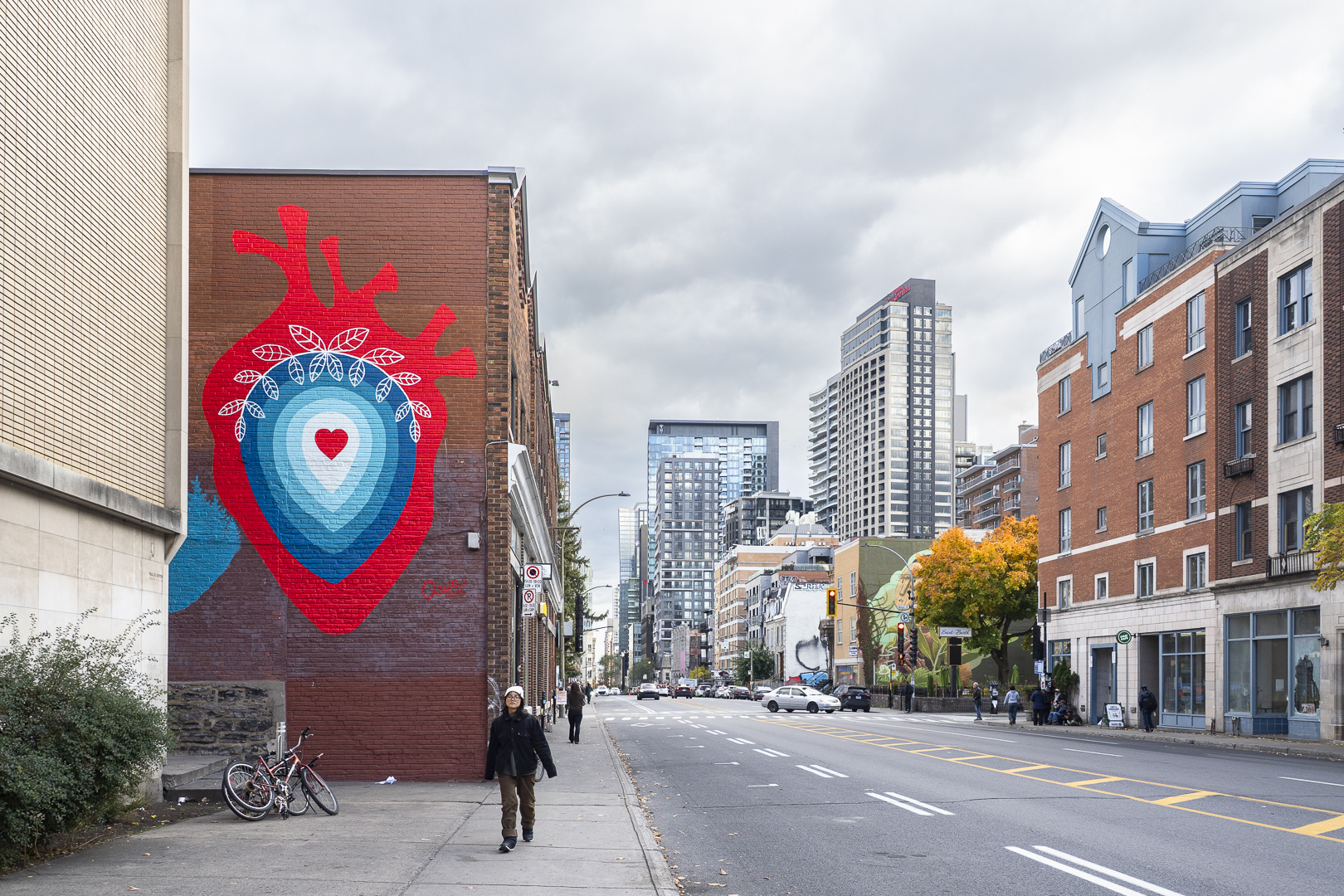
This mural is part of the ARRUE initiative by the Government of Quebec, which aims to raise awareness among citizens in the cities of Quebec, Gatineau, and Montreal about the challenges faced by people experiencing housing insecurity through public art projects.
The City of Montreal seeks to foster dialogue with its marginalized Indigenous populations and has partnered with MU, recognized both as a mural producer and an ally of Indigenous peoples.
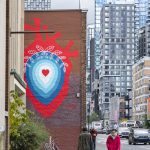
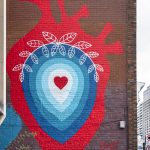
The mural was created by Atikamekw artist Eruoma Awashish, who chose to paint a large heart so that the narrative and message would be simple, direct, and universal. The heart—Eruoma’s artistic signature—is a complex and multifaceted concept, tied to life itself and the vital force that animates all living beings. For some, the heart is also a passageway, a bridge between the physical and spiritual worlds, allowing communication with spirits and ancestors. It is a symbol of emotion, love, spirituality, and connection with the world, linking all living beings, including nature. Eruoma also incorporated motifs of medicinal plants known to Indigenous Peoples.
Cultural mediation workshops were held at the Milton Parc Community Gardens with Mohawk and Paiute artist Leilani Shaw. Additional workshops took place at the foot of the mural with participants from the Open Door shelter and the Milton-Park Art Hive.